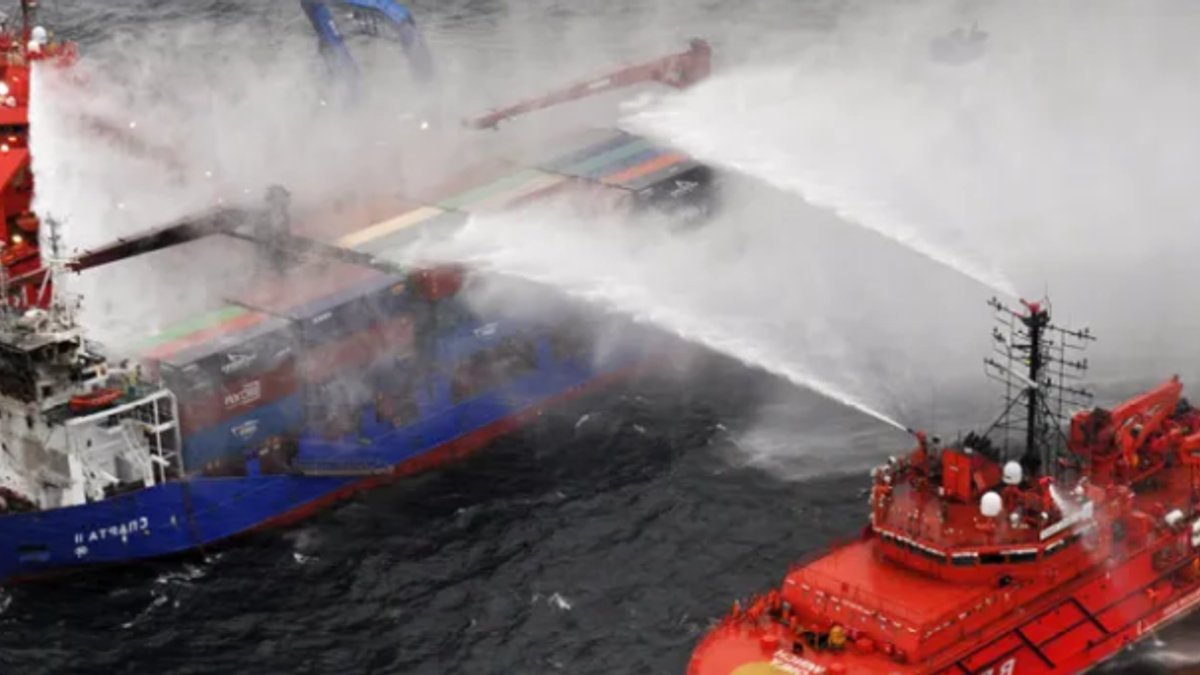
Finland’s economic zone was exited by the damaged Russian cargo ship Sparta II on November 22, Sunday, as reported by Yle, marking the conclusion of the Finnish Border Guard’s rescue operation.
The departure followed a drone strike on Saturday and a fire that brought Finnish, Estonian, and Russian vessels into a joint rescue effort in the Gulf of Finland. All 16 crew members were evacuated, with one suffering a slight injury, Reuters reported.
Finnish authorities have since relaxed maritime and airspace restrictions around the area, Yle confirmed in its evening report. The update clarified that Sparta II had exited both Finland’s economic zone and the region where Finland was responsible for preventing environmental harm.
Finland’s Interior Minister, Mari Rantanen, stated that officials had brought the situation under control and prevented any ecological damage, as reported by Yle. Prime Minister Petteri Orpo expressed gratitude to the rescue teams and acknowledged Estonia’s contribution, specifically the deployment of its vessel, Kindral Kurvits.
A multinational effort to stabilize the ship
The Russian rescue ship Murman began pulling Sparta II away on Sunday afternoon. The Finnish Border Guard confirmed in a statement that while the vessel was leaning slightly, it remained seaworthy enough to be moved.
Thermal cameras showed some containers were still warm, though no flames were visible externally. The operation aimed to first move the ship beyond Finnish territorial waters, then beyond Finland’s maritime rescue responsibility area.
The tow operation within Finland’s jurisdiction was supported by the Finnish patrol boat Uisko, Estonia’s Kindral Kurvits, and tugboats from Alfons Håkans. A Border Guard helicopter continuously monitored the cargo ship’s condition and any risks to the surrounding marine environment.
Read Also: Man sentenced for US assassination plot
The Border Guard confirmed no fuel or hazardous-substance leaks were detected. Responsibility would transfer once the vessel left the Finnish area, ending the Finnish rescue mission.
Reuters identified seven vessels that combatted the fire: two from Russia, two from Estonia, and three from Finland. The effort united crews from Russia, Finland, and Estonia—both NATO allies—under Finnish leadership.
Before the tow began, the crew was evacuated. The Border Guard’s Saturday evening report placed Sparta II anchored near Loviisa, still burning. The team abandoned ship in lifeboats before boarding a nearby cargo vessel.
A restricted area was established around the site. Finnish resources included Uisko, patrol boats, a surveillance aircraft, and helicopters. The rescue tugs Ajax and H. Kanter also participated in firefighting and cooling.
Murman joined at the Finnish Border Guard’s request. The agency prepared for marine-pollution response with rescue departments, planning to tow the disabled ship into the Russian responsibility area. Environmental protection was part of this plan.
The Saturday statement noted no known danger to surrounding maritime traffic. It also mentioned a separate investigation into an aircraft’s suspected violation of Finnish airspace, which continued during the rescue.
Firefighting required managing the ship’s stability. The Border Guard’s Sunday morning update stated firefighting and cooling continued with multiple units, including Estonian and Russian resources. Uisko coordinated under Finnish leadership.
Read Also: Senate rejects Iran war powers measure
Water use was constrained to prevent accumulation inside the hull, which could destabilize or sink the ship. The task involved both fire suppression and vessel condition management.
The later towing announcement followed efforts to stabilize the ship for movement.
Weather was another concern. Yle reported maritime operations director Jukka-Pekka Lumilahti’s account of winds of seven to ten meters per second and waves of one to two meters. Conditions were expected to worsen the following day as authorities worked to move the vessel.
Unidentified cargo and international implications
Earlier on Sunday, Yle cited coast guard commander Joni Sjöberg, who said firefighting efforts continued overnight and into the morning.
Sjöberg confirmed the crew’s evacuation and transfer to a Russian rescue vessel. The operation also involved cooling Sparta II’s containers, whose contents were unknown, according to Yle.
Sparta II, a 121-meter Russian-flagged cargo ship operated by Oboronlogistika, a company linked to Russia’s Defense Ministry, was en route from St. Petersburg to Kaliningrad when it was struck.
Kaliningrad is Russia’s Baltic exclave between Poland and Lithuania. Euronews reported the ship was struck by two drones in the eastern Gulf of Finland, west of Gogland Island, on November 21. It caught fire, lost maneuverability, and drifted into Finnish territorial waters.
Read Also: Cody Johnson Withdraws from CMA Awards Due to Exhaustion
The Finnish military assessed Ukraine as likely responsible. Ukrainian authorities had not publicly confirmed this in Sunday’s reporting. The assessment did not establish the attacker’s identity or strike purpose, and no confirmed account identified military equipment aboard.
The U.S. Treasury’s Office of Foreign Assets Control listed Sparta II in a May 8, 2022 sanctions update. The entry identifies it as a Russian-flagged roll-on, roll-off vessel with International Maritime Organization number 9160994.
The entry links the vessel to Oboronlogistika and records a gross tonnage of 7,260. It appears among vessels added to the Specially Designated Nationals list under Executive Order 14024. The record dates to 2022, before the November 2026 fire and rescue.
Yle reported Finnish authorities considered seizing the ship but deemed towing the burning vessel toward shore too risky for maritime and environmental safety. Border Guard maritime-safety director Mikko Hirvi said Russia towing it away was Finland’s best option.
Henrik Ringbom, a maritime-law professor at Åbo Akademi University, told Yle inviting Russian vessels to help was standard in maritime emergencies. He emphasized the vessel’s distress and the need to rescue its crew, despite Russia’s war against Ukraine.
Yle’s Sunday evening update, citing the coast guard, confirmed the ship had left Finland’s responsibility area, ending the mission.