
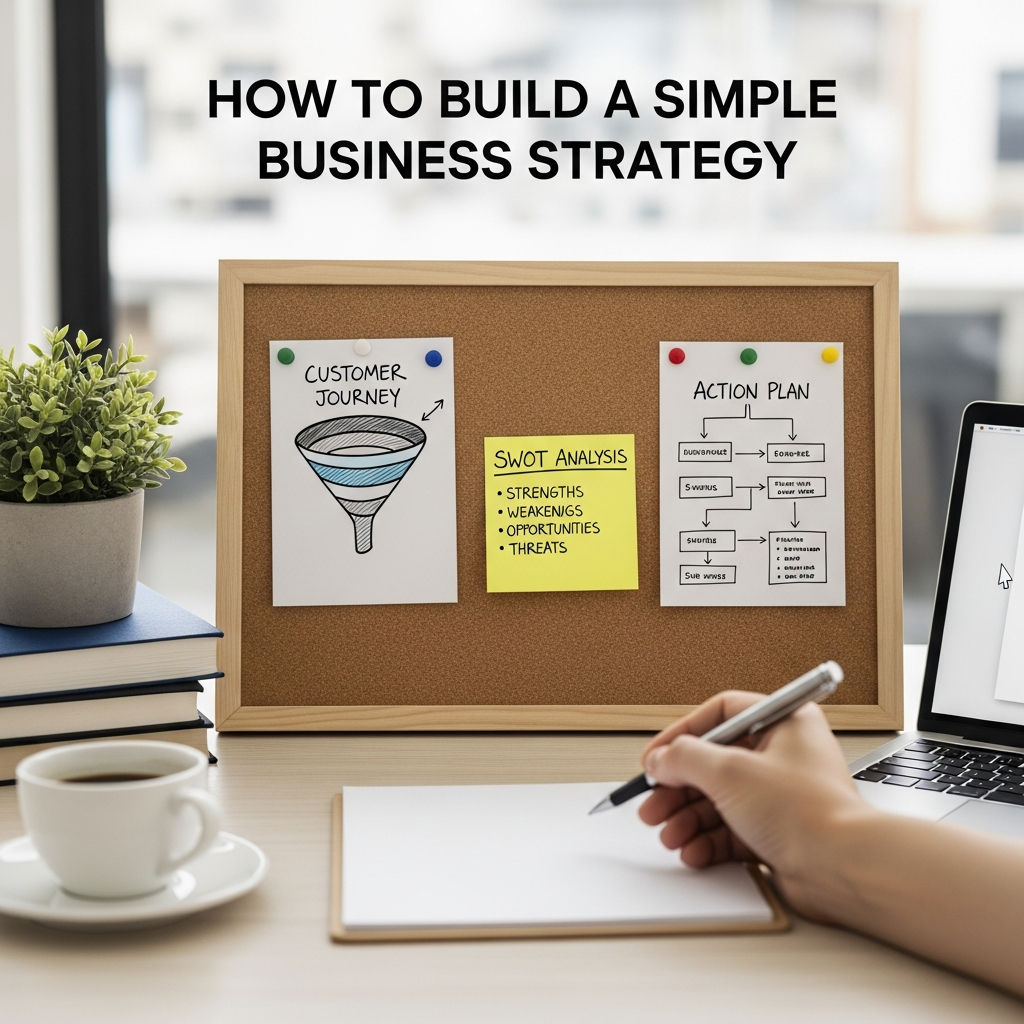
How to Build a Simple Business Strategy: Your Roadmap to Success
In the bustling world of business, it’s easy to get caught up in day-to-day operations and lose sight of the bigger picture. Many entrepreneurs and established business owners alike shy away from the idea of “strategy,” viewing it as an overly complex, time-consuming exercise reserved for large corporations. However, nothing could be further from the truth. A simple, well-defined business strategy is not a luxury; it’s a fundamental necessity. It acts as your compass, guiding your decisions, aligning your team, and keeping you on track toward your ultimate objectives. This article will demystify the process, breaking down how to build a simple business strategy that is actionable, adaptable, and genuinely effective for businesses of any size.
What is a Business Strategy, Anyway? (And Why Simplicity Matters)
At its core, a business strategy is an overarching plan that outlines your long-term goals and how you intend to achieve them. It’s about making choices – choosing what to do, and equally important, what not to do. It sets the direction for your entire organization, allocating resources, and defining your competitive advantage. Think of it as the ‘why’ and ‘what’ before you get to the ‘how.’
Why emphasize simplicity? A simple business strategy is easier to communicate to your team, easier to remember, and crucially, easier to execute. Overly complex strategies often lead to confusion, paralysis by analysis, and a lack of momentum. By focusing on the essentials, you create a dynamic, living document that can adapt as your business and market evolve, preventing the common trap of having a detailed plan that no one understands or follows.
Step 1: Define Your Vision and Mission (Your North Star)
Before you can chart a course, you need to know your destination. Your vision and mission statements are the foundational elements of any simple business strategy. They articulate your purpose and aspirational future.
- Your Vision: This is your aspirational future state. What does success look like in 5, 10, or 20 years? What impact do you want to make on the world, your industry, or your customers? Your vision should be inspiring, challenging, and long-term.
- Your Mission: This describes what your business does, for whom, how it does it, and why. It’s your company’s reason for being, a statement of your core purpose and values.
Keep both concise and memorable. For example, a vision might be “To be the leading provider of sustainable packaging solutions in North America,” while a mission could be “To empower businesses with eco-friendly packaging that protects products and the planet.”
Step 2: Understand Your Current Landscape (SWOT Analysis)
Once you know where you’re going, you need to understand your starting point. A SWOT analysis is a powerful yet simple tool for assessing your internal and external environment. It helps you identify critical factors that will influence your strategic choices.
- Strengths (Internal, Positive): What does your business do well? What unique resources or capabilities do you possess? (e.g., strong brand reputation, talented team, proprietary technology).
- Weaknesses (Internal, Negative): Where does your business need to improve? What are your limitations or disadvantages? (e.g., limited budget, lack of market penetration, outdated technology).
- Opportunities (External, Positive): What favorable external factors could you leverage? What trends could benefit your business? (e.g., emerging market, new technology, favorable regulatory changes).
- Threats (External, Negative): What external factors could harm your business? What challenges do you face from competitors or the market? (e.g., new competitor, economic downturn, changing consumer preferences).
Use the insights from your SWOT to leverage your strengths, address weaknesses, capitalize on opportunities, and mitigate threats. This analysis provides a realistic snapshot that informs your strategic direction.
Step 3: Set Clear, Achievable Goals (SMART Framework)
With your vision and mission defined and your landscape understood, it’s time to set specific objectives. These are the measurable milestones that tell you whether you’re progressing towards your vision. The SMART framework is an indispensable tool for setting effective goals:
- Specific: Clearly defined, leaving no room for ambiguity. Instead of “increase sales,” say “increase online sales.”
- Measurable: Quantifiable, so you can track progress. “Increase online sales by 20%.”
- Achievable: Realistic and attainable, even if challenging. Is 20% realistic given market conditions?
- Relevant: Aligned with your overall vision and mission. Does this goal contribute to your long-term success?
- Time-bound: Have a clear deadline. “Increase online sales by 20% by the end of Q4.”
Examples of SMART goals might include: “Reduce customer churn by 10% within the next 6 months,” or “Launch a new product line targeting Gen Z by Q3 next year.” Aim for 3-5 core strategic goals to keep your focus sharp.

Step 4: Identify Your Core Strategies (The “How”)
These are the broad approaches you’ll take to achieve your SMART goals. They are not specific actions yet, but rather the overarching methods that will guide your decisions. Based on your SWOT analysis and goals, choose 2-3 core strategies that will have the biggest impact.
- Cost Leadership: Aim to be the lowest-cost provider in your market.
- Differentiation: Offer unique products or services that customers value and are willing to pay a premium for.
- Niche Market Focus: Target a specific, narrow segment of the market with specialized offerings.
- Innovation: Continuously develop new products, services, or processes.
- Customer Experience Excellence: Provide outstanding service and build strong customer relationships.
For instance, if your goal is to “Increase market share by 15% in the next 12 months,” your core strategies might be “Product Innovation” and “Aggressive Digital Marketing.”
Step 5: Outline Key Tactics and Actions (The “What Exactly”)
Now, it’s time to break down your core strategies into specific, actionable tactics and initiatives. These are the concrete steps that individuals or teams will take to execute your strategies and achieve your goals. For each core strategy, list 3-5 key tactics.
If your strategy is “Product Innovation,” your tactics might include:
- Invest 15% of annual revenue into R&D for new feature development.
- Conduct quarterly customer feedback surveys to identify pain points and desired features.
- Implement a rapid prototyping and beta testing program for new product iterations.
- Form a dedicated cross-functional innovation task force.
Assign responsibilities, establish deadlines, and allocate necessary resources for each tactic. This level of detail transforms your strategy from an abstract idea into a tangible plan.
Step 6: Implement, Monitor, and Adapt (The Iterative Process)
A strategy is useless without implementation and ongoing review. This isn’t a one-and-done exercise; it’s a continuous cycle. Once you have your simple business strategy documented:
- Execute with Discipline: Communicate the strategy clearly to all relevant team members. Ensure everyone understands their role in achieving the goals.
- Monitor Progress Regularly: Establish Key Performance Indicators (KPIs) for each goal and tactic. Review these metrics weekly or monthly to track progress. Are you on track to meet your SMART goals?
- Be Prepared to Adapt: The business environment is constantly changing. If market conditions shift, if a tactic isn’t working as expected, or if a new opportunity arises, be flexible enough to adjust your strategy. A simple strategy is inherently more agile.
- Celebrate Successes and Learn from Failures: Acknowledge milestones achieved and openly discuss what didn’t work. Use these learnings to refine your approach.
This iterative process ensures your strategy remains relevant, effective, and a true guide for your business.
Common Pitfalls to Avoid When Building Your Strategy
- Overcomplication: The most common mistake. Keep it simple and focused.
- Lack of Buy-in: If your team doesn’t understand or believe in the strategy, it won’t be executed effectively. Involve key people in the planning process.
- No Clear Accountability: Without assigned responsibilities and deadlines, tactics become wishes, not actions.
- Forgetting to Review and Adapt: A static strategy quickly becomes obsolete. Treat it as a living document.
- Confusing Strategy with Tactics: Remember, strategy is the ‘what’ and ‘why,’ tactics are the ‘how.’
Conclusion: Your Simple Strategy, Your Clear Path Forward
Building a simple business strategy doesn’t require an MBA or a huge budget. It requires clarity, focus, and a commitment to understanding your business and its environment. By following these six straightforward steps – defining your vision and mission, analyzing your landscape, setting SMART goals, identifying core strategies, outlining tactics, and continuously monitoring and adapting – you can create a powerful roadmap that drives your business forward. Stop dreading strategy and start building yours today. A clear path to success is within your reach, powered by the simplicity and power of a well-crafted business strategy.